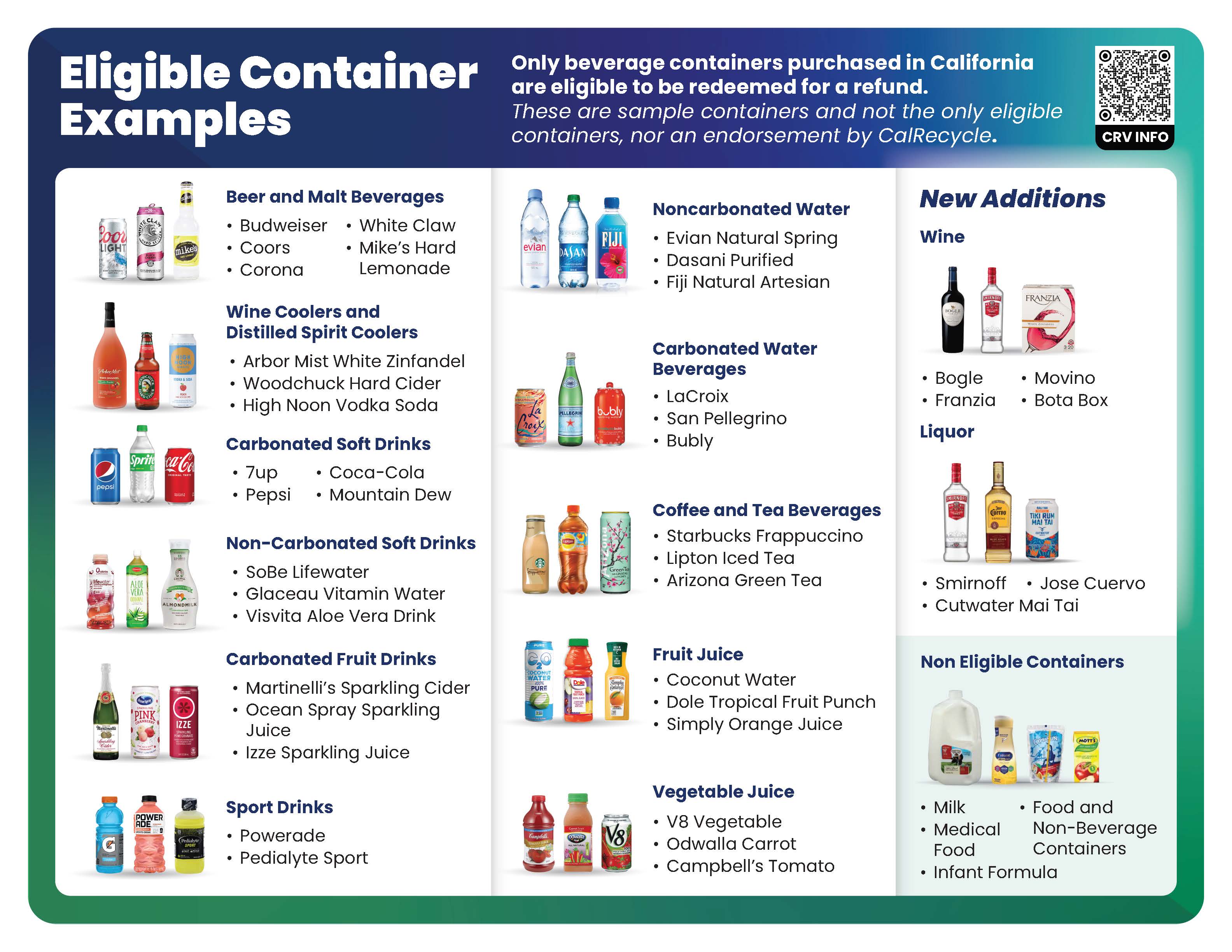
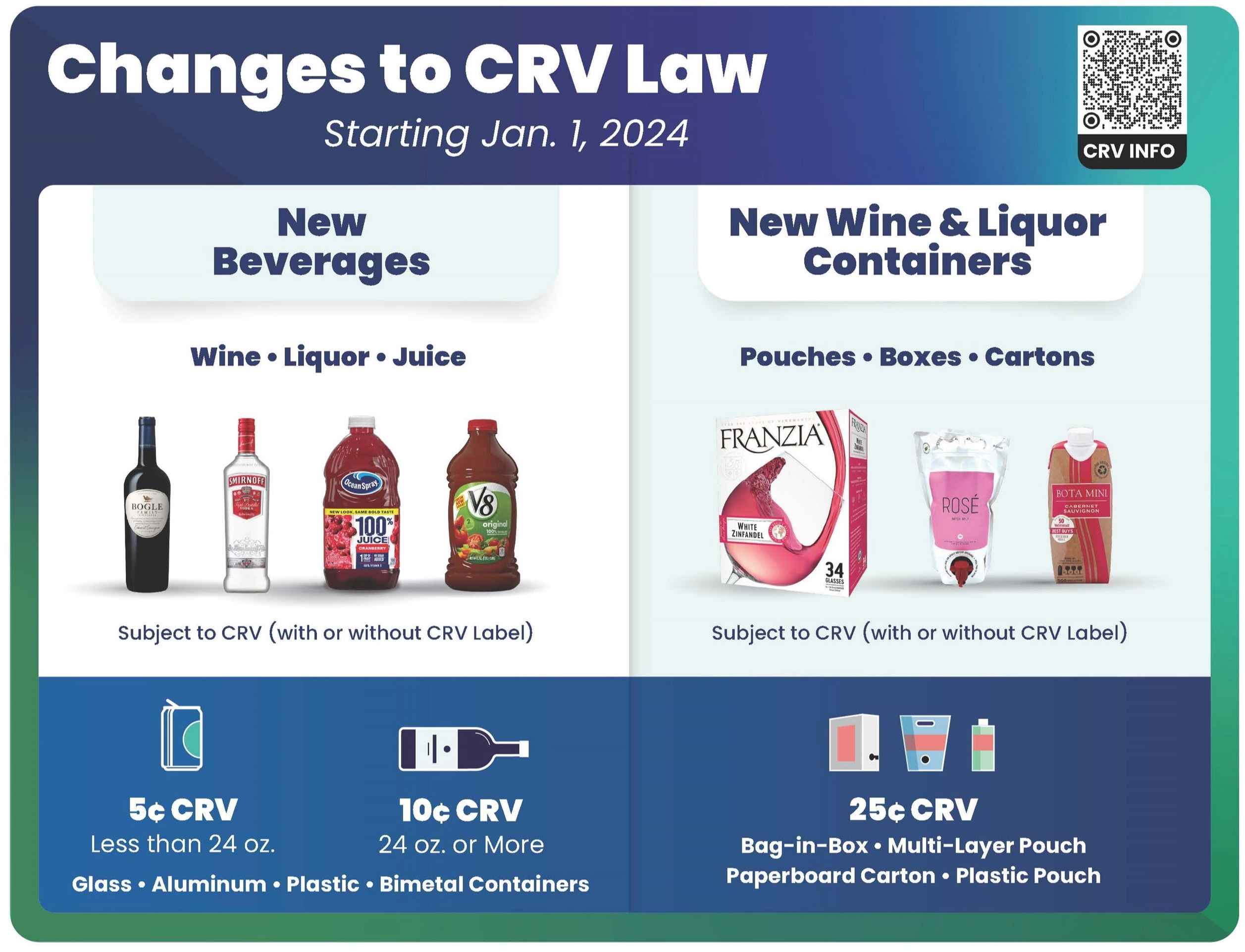
In 1987, the State of California passed the California Beverage Container and Litter Reduction Act to provide an incentive to help increase beverage container recycling rates. The act requires consumers purchasing beverage in certain recyclable bottles and cans in California to a deposit referred to as California Redemption Value (CRV) at the point of purchase. The deposit is 5 cents on containers less than 24 ounces and 10 cents on containers 24 ounces or larger.
Thanks to this cash incentive, more than 230 billion aluminum, glass, and plastic beverage containers have been recycling since the program first started, but work is still needed. In 2018, Californians bought 24.5 billion California Redemption Value (CRV) eligible containers (glass, aluminum, plastic). Over 18.5 billion of those containers were recycled saving natural resources, conserving energy, and extending saving natural resources, conserving energy, and extending the life of our landfills. However, nearly 6 billion beverage containers were tossed in the trash and disposed in California landfills amounting to $100 million in unclaimed CRV.
For more information on recycling centers visit: CalRecycle and view acceptable items for recycling. Link to website to find recycling centers by location: https://www2.calrecycle.ca.gov/BevContainer/RecyclingCenters.
CRV Center
Ponce Recycling
18405 Brookhurst Street
Fountain Valley, CA 92708
714-794-7542
Open: 9:00 a.m. - 5:00 p.m.
Monday - Saturday
Closed Sunday | JJ Recycling 16163 Harbor Blvd
Fountain Valley, CA 92704
714-719-1777
Open: 8:00 a.m. - 5:00 p.m.
Monday - Saturday
Closed Sunday |
Assembly bill 341 mandatory commercial recycling
California Assembly Bill 341 requires all commercial businesses and multi-family properties to recycle. The legislation became effective July 1, 2012, and was designed to help meet California's recycle goal of 75% by the year 2020.
Assembly bill 1826 mandatory organics recycling
Assembly Bill 1826 requires all businesses that generate a certain amount of organic waste (food waste) to develop a program to recycle that waste. Organic waste includes food scraps, vegetable trimmings, plate scrapings, and spoiled food. The city's waste hauler, Republic, has developed a Food Recycling Program to help businesses meet the requirements of Assembly Bill 1826.
To comply with the law, businesses can select from any combination of these food-recycling options:
- Recycle food scraps
- Donate edible food to a food bank
- Self-haul food scraps
In partnership with its waste hauler, the city provides complimentary technical assistance to help businesses comply with these laws.
Republic Services provides recycling to single, multi-family, and business as part of its agreement with the city. Here's is a partial list of materials that can be collected as part of the recycling program:
- Anything that tears
- Cardboard (flattened)
- Cereal boxes (liners removed), and other food boxes
- Computer paper, white paper, mixed paper
- Empty aerosol cans
- Glass jars and bottles*
- Metal food and soup can*
- Pie tins*
- Plastic containers (labeled #1-7)
- Plastic shopping bags (place bags inside each other to create one large bundle)
- Plastic water and soda bottles*
- Soda cans*
- Telephone books
- Tissue and soda boxes
- Wine and Liquor bottles*
*Please lightly rinse food residue from containers*
Do NOT place items in recycling bins (Please Put These Items in Trash Bin):
- Carpeting
- Ceramic items
- Clothing (donate them)
- Disposable diapers
- Drinking glasses
- Empty motor oil or containers
- Empty paint cans
- Mirrors, window glass, auto glass
- Pet Waste
- Rubber latex items
- Soiled paper towels or plates
Below is a list of materials that can be collected as part of recycling program: